

















- Turrets: +20% damage from melee
- Backdoor protection: −80%
- Waves every 25 s from 14:00
- Inhibitors back in 5:00
One champion, two enemies busy. That's the whole trade.
A split pusher wins when the enemy has to send more players to the side lane than you sent — or lose the turret.
- Side wave pushingArrive with or behind your wave — backdoor protection cuts turret damage by 80% without minions.
- You win or escape the 1v1Beat whoever comes, or leave before two arrive.
- Vision on the entrancesWards on the paths into your lane; a faelight superward if one is close.
- Team can stallWaveclear in mid and no 4v5 fights.
- An objective to tradeBaron, a drake or a turret your team takes when they answer you.
Schematic, not to scale. Turret rules: Riot's patch 26.1 notes and Data Dragon 16.22.1. Checklist: BoostPirate's coaching. Live patch 26.22, checked 8 November 2026.
Split pushing is the late-game plan where one champion takes a side lane alone and pushes it towards the enemy's base while the other four play elsewhere. Done well, it forces the enemy into an impossible choice: send players to stop the push and lose the fight or objective across the map, or ignore it and lose turrets and inhibitors. Done badly, it's a 4-versus-5 fight your team loses while you farm. In 2026 Riot rebuilt turrets partly to help — its season preview admitted that "splitting and sieging aren't currently in great states" — so this guide covers the new rules on patch 26.22, when to split, who does it best, and what your team does while you're away.
- The trade is numbers: one of you should tie up two of them, or take a structure.
- Never push ahead of your wave — backdoor protection returns 3 seconds after minions leave.
- Side waves grow fast: every 25 seconds from 14:00, a cannon in every wave from 25:00.
- Top laners can Teleport back — the Top Role Quest gives Unleashed Teleport even to those who didn't take it.
- Split only with a team that can stall; otherwise group and push side waves first.
What split pushing is — and isn't
Split pushing isn't farming a side lane while your team fights without you. The point is pressure: your wave and your damage threaten a structure, so the enemy has to react. Every second an enemy spends walking to your lane is a second they aren't at Baron or in mid. If the enemy can ignore you, you're not split pushing; you're just absent.
They send one equal champion. Even trade — you need to win the duel or keep the wave pushing.
Your team has a 4-versus-3 elsewhere. Escape alive and the plan has worked even if you lose the turret.
They fight your four with five. If they can win that faster than you can take the base, don't split.
When to split — and when to group
- Laning is over — usually after the first turrets have fallen and the team starts grouping around objectives.
- Your side wave is big and pushing, or you can build it: slow-push one wave into the next before you arrive at the turret.
- You have an answer to the responder: you beat them one-on-one, or you have Flash, a dash or Teleport to leave.
- Wards cover the jungle entrances to your lane, so you see a collapse ten seconds early.
- Your team knows the plan and has waveclear to hold mid without fighting.
- You're the best duelist in the game
- The next objective is a minute away
- Your team has waveclear and disengage
- The enemy has no one who wins your lane
- Baron, a soul point or Elder is up now
- Your team needs you to fight at all
- You can't see the enemy jungler
- A global ultimate or a hard engage can catch you alone
Who splits best
Any champion can push a side wave, but a split pusher needs one or more of four things. Example kits, from Riot's ability text in Data Dragon 16.22.1:
 Duelistswin the 1v1
 Fiora — Grand Challenge reveals four Vitals; hitting them all heals her and nearby allies.
 Jax — Counter Strike dodges attacks, then stuns everyone nearby.
 Hard to killsurvive the 1v2
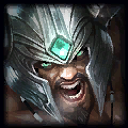
 Tryndamere — Undying Rage stops him dying for a short time: long enough to finish a turret or walk away from two.
 Structure killerspressure without you
 Yorick — Mist Walkers and the Maiden of the Mist fight alongside him, so one champion brings a small army to the lane.
 A way backjoin the fight
 Shen — Stand United shields an ally anywhere and teleports him there. Teleport does the same job for other top laners.
These are examples of kit features, not a tier list — check the current patch before you pick for a split plan. What matters more than the name is the checklist: can this champion take a turret fast, survive the first responder and get back?

How turrets work in 2026
Patch 26.1 rebuilt turrets, and most of the changes reward exactly what a split pusher does — small, repeated pushes. The rules on the live patch:
Plates stay for the whole game — they no longer fall off at 14:00, and inner and inhibitor turrets have plates too: 600 gold across 5 plates. Riot's aim: "mine some gold out of aggressive actions". Every plate you chip is gold, even if the turret survives.
Since 26.1 turrets take 20% more damage from melee champions — it replaced a rule that made plates take less damage from minions and ranged champions.
Turrets take 80% less damage from every source, true damage included, while no enemy minions or summoned Rift Herald are near — and it comes back 3 seconds after they leave.
Since 26.1 your third attack on a turret deals bonus damage — 85 + 28% of your max health melee, 50 + 20% ranged, 30 s cooldown.
Crystalline Overgrowth is the 2026 mechanic built for side lanes — Riot wanted "champions of any role or class to make some pushing progress". Crystals grow on a lane turret over time and burst for bonus true damage the next time an enemy champion attacks it:
- Damage scales with the attacking team's average level: 2–3.3% of the turret's max health at level 1, 8.8–18.9% at level 18 — not with your own stats.
- It doesn't proc during backdoor protection, so it's another reason to arrive with your wave.
- If enemies are near when it would appear, it waits until they leave, then catches up to where it should be.
- Practical rule: a turret nobody has hit for several minutes is a free chunk of health for the first champion who touches it — rotate side lanes to find those turrets.
Wave timing for side lanes
A split push is only as strong as the wave behind it. From 14:00 waves spawn every 25 seconds with a cannon in every second wave; from 25:00 every wave has a cannon, and from 30:00 they come every 20 seconds. That makes the side lanes the fastest growing source of pressure in the late game:
- Arrive and clear the enemy wave fast, so your next wave and the leftovers meet as one big wave.
- Walk in behind it. Let your minions tank the first turret shots; that's also when Crystalline Overgrowth can proc.
- Hit plates first — each one pays, even if the turret survives the push.
- Leave before the collapse. When the wave dies or two enemies go missing, walk out. A dead split pusher hands the enemy the 5v4.
The wave management guide explains slow pushes and crashes in detail, and the macro guide covers side lanes in the wider plan.
Vision and escape routes
A split pusher dies to what they can't see. Patch 26.1 added two map features that help side-laners in particular:
Rings of glowing mushrooms; some exist from the start, more appear with the Elemental Rift. A ward on a faelight becomes a superward: 25% more vision radius and a bonus vision area for 45 seconds.
New spots near the side lanes and behind each side lane's inner turret, respawning every 90–120 seconds — Riot calls them helpful "when trying to safely exit your base when behind".
Ward the jungle entrances to your lane before you push past the river. A Control Ward on the main route is the best-value insurance in the game.
After 14:00, 150% movement speed ramping down to 65% over 4 seconds after 14:00 — no fixed duration. Recalling and walking back is quicker than it used to be.
The vision guide covers ward placement around objectives.
1-3-1 or 1-4?
Pick the side lane on the opposite side of the map from the objective you want: splitting bottom while your four set up Baron makes the enemy choose between the two most expensive things on the map.

What the other four do
Clear mid waves under your turret and refuse fights. Waveclear and disengage matter more than damage here.
When two enemies go to the split pusher, take Baron, a drake or a turret on the other side — that's the payoff.
If all five enemies show up, give ground. Losing a turret is fine; losing a fight hands them Baron.
An enemy who's missing is often waiting. Sweep, ward, then move.
Communication decides whether a split works in solo queue. Ping your plan before the objective, ping when you see two enemies coming to you — "two bot, take Baron" — and use the communication guide's short calls.
Teleport and the Top Role Quest
Teleport is what turns a split pusher into a five-player team when it matters. On the current rules:
- Teleport has a 3-second channel to an allied turret, and from 10:00 it upgrades to Unleashed Teleport, which can also target minions and wards (330–240 s by level cooldown).
- The Top Role Quest gives a top laner who didn't take Teleport an Unleashed Teleport on a 390-second cooldown; one who did take it gets a shield on arrival and a shorter cooldown instead.
- Use it to join, not to escape. Push, back off when the enemy commits, and Teleport into the fight or onto the objective your team is starting.
Our Role Quests guide and summoner spells guide cover the details.

Closing the game from a side lane
Late split pushes end games because of what happens after an inhibitor falls: one super minion per wave in a lane whose inhibitor is down — two per lane once all three are down, and the inhibitor only returns after 5:00. Combine that with Baron — an empowered Recall at half the channel time, +50% homeguard speed and empowered nearby minions — siege minions gain +750 range — and side lanes push themselves.
Those death timers (the official wiki's formula, as our teamfighting guide uses it) are the window a split pusher plays for late: one enemy caught means close to a minute of four-versus-five. That's the moment to stop splitting, group and end — or to take an inhibitor alone while they're dead.
Common split-pushing mistakes
- Push with your wave and hit plates first.
- Ward the entrances before you pass the river.
- Leave as soon as two enemies go missing.
- Tell your team which objective to take when you draw two.
- Re-check turret rules after patches — 26.23 lands 18 November 2026.
- Split while Baron, Elder or soul point is being contested.
- Hit a turret with no minions — it takes 80% less damage.
- Push past the river without vision or Teleport.
- Die to the responder and hand them a 5v4.
- Ask four teammates to stall without waveclear.
Side-lane decisions are easiest to learn on replay. A 1-on-1 coach (from $22.00 an hour) pauses your games at every split and group call. Want the climb now? A verified booster plays your roles through a Solo/Duo boost.
Read next: power spikes, roaming, Baron and the macro guide.
- Riot Games — Patch 26.1 notes (January 2026: turret health and plates, +20% melee damage to turrets, Crystalline Overgrowth, Demolish, minion waves, Homeguard, Faelights, Scryer's Blooms, Top lane Teleport) · /dev: 2026 Season One gameplay preview (1 Dec 2025: quotes) · Patch 26.22 notes (3 November 2026: no turret, minion or Teleport changes) · Data Dragon 16.22.1: items ("Reinforced Armor": 80% less damage without enemy minions or Rift Herald) and champion ability text (Fiora, Jax, Tryndamere, Yorick, Shen)
- LoLTheory — What is backdooring (updated 25 Aug 2026: true damage included, returns 3 s after minions leave)
- Minion waves, Teleport, Top Role Quest, inhibitors, super minions, Baron and death timers: our LoL data file, from Riot's notes and the official wiki (see the wave management and teamfighting guides). Checked 8 November 2026. The checklist, formations and team advice are BoostPirate's coaching.
All free tools: calculators, percentiles & season countdowns →
Common questions
What is split pushing in League of Legends?
When should you split push?
Did 2026 make split pushing better?
What is backdoor protection?
What is a 1-3-1 in League?
Ready to climb the Rift?
1-on-1 Coaching
A Master+ coach reviews your builds, fights and side-lane calls on your own replays.
Solo/Duo Rank Boost
A verified booster plays your roles and champions to the rank you pick.
Ranked Net Wins
A fixed number of net wins at your tier — climb while you practise.
More League of Legends guides
All League of Legends guides →
League of Legends and all related assets are © Riot Games; splash art via Data Dragon. BoostPirate isn't endorsed by Riot Games.
